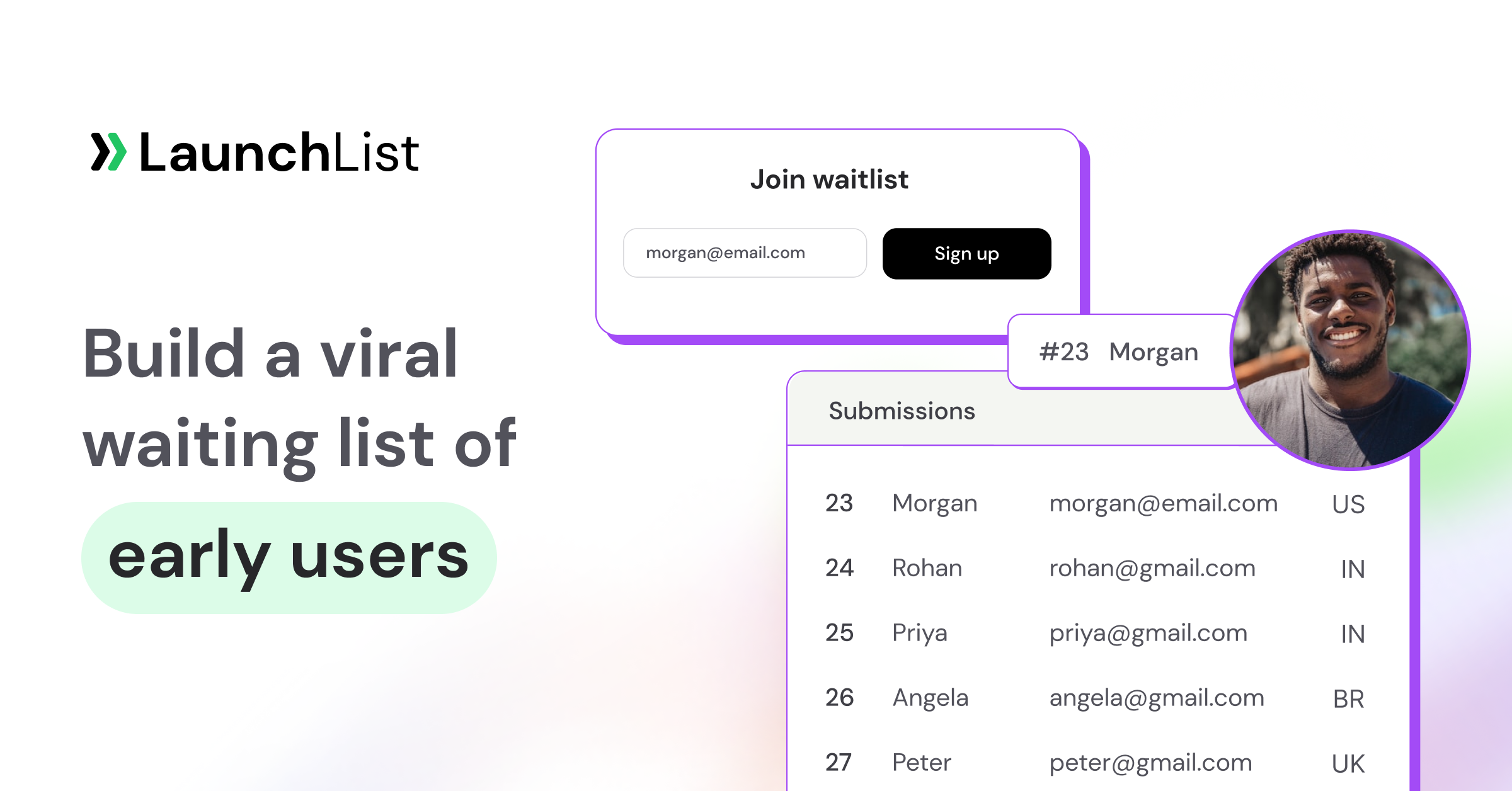
TL;DR: A pre-launch waitlist is a curated list of people who've signed up to be notified (or to get early access) when your product ships. Done right, it's three things at once: a demand-validation tool, a launch-day audience, and a growth loop that compounds while you build. The mechanics that separate a working waitlist from a dead one are clear — a specific pitch, a referral mechanic on the success page, consistent updates, and a launch moment worth waiting for. This guide walks through what a pre-launch waitlist actually is, when to start one, and the four components that make it compound.
The short definition
A pre-launch waitlist is a list of email signups collected before a product launches. It sits between three adjacent concepts:
- A coming soon page — the page where you collect signups. The waitlist is what you do with the signups afterward.
- A newsletter — ongoing content for an audience. A waitlist is tied to a specific product launch event.
- A beta program — a subset of the waitlist gets early access. The beta is a product state, the waitlist is the list that feeds it.
The waitlist is the data and engagement layer — the people, their referral links, their signup positions, and everything you send them between signup and launch. The coming soon page or waitlist landing page is the capture surface.
Why pre-launch waitlists work
Three reasons founders build one before shipping:
1. Demand validation at zero cost
A waitlist tells you whether your positioning resonates before you invest in building. If your page gets 200 visitors and 80 signups (40%), you have real demand. If it gets 2000 visitors and 4 signups (0.2%), you have a positioning problem — better to discover it now than after you've shipped.
2. A launch-day audience
Launching to an engaged list of 2000 beats launching to a cold audience of zero. Every person on a well-run waitlist is a potential day-one customer, reviewer, and referrer. Product Hunt launches with pre-built audiences routinely hit Top 3; cold launches rarely do. See our how to launch on Product Hunt 2026 guide for the full playbook.
3. Compound growth via referral loops
With a referral mechanic, each signup can bring more signups. The viral coefficient math — K = i × c — determines whether your list doubles in days or crawls linearly. A working waitlist with K > 1 is a machine that builds itself; without the loop, you're paying for each signup one by one.
Pre-launch waitlist vs other "lists"
| Pre-launch waitlist | Newsletter | Customer email list | Beta program | |
|---|---|---|---|---|
| Product state | Not yet launched | Content-focused, ongoing | Paying / active users | Invited early-access subset |
| Primary signup motivation | Be notified / get early access | Ongoing value from content | Product use | Specific access to unfinished product |
| Typical lifespan | Weeks to months | Years | Years | Weeks to months |
| Referral mechanic | Almost always | Sometimes (Morning Brew-style) | Occasional | Rarely |
| Post-signup UX | Position + share link | Welcome email sequence | Onboarding / account | Access details + feedback flow |
| Graduation | Launch → converts to customer list | Stays as newsletter | — | Launches with other waitlisters |
Most founders blur these. A pre-launch waitlist is specifically a bridge from "interested" to "customer", tied to a specific launch event and usually retired or transformed after.
The 4 components of a working pre-launch waitlist
1. A specific, believable pitch
"Something exciting is coming" is not a pitch. "The Figma for audio production, launching Q3" is. The pitch lives in your waitlist landing page headline and repeats in every email. If the pitch isn't clear in 5 seconds, the waitlist won't grow — because nobody will refer a product they can't explain to friends.
2. A capture surface (coming soon page)
The landing page is where the pitch converts to signup. Best-in-class pages hit 25–45% conversion on warm traffic. For the anatomy of these pages, see our waitlist landing page examples. For a diagnostic if yours isn't converting, see why is my waitlist not converting.
3. A referral mechanic on the success page
After signup, the user sees their position and a share link. This is the single biggest leverage point — without it, each signup is a dead-end. With it, each signup has a non-zero chance of bringing 2–5 more. For the mechanics, see our rewards and milestones guide and the deeper viral loop breakdown.
4. A communication drip between signup and launch
The silent period between "I joined your waitlist" and "you finally launched" is where most waitlists die. A well-run waitlist sends a welcome email immediately, updates every 2–4 weeks (progress, decisions, screenshots), a launch-week teaser, and a launch-day invite. For templates, see 12 waitlist email templates that get opened.
When should you start a pre-launch waitlist?
The optimal window is 2–6 months before launch. Earlier and signups go cold before you ship; later and you miss the opportunity to validate demand and build the launch audience.
Start sooner (3–6 months out) if:
- You're building something complex that needs market signal before more investment
- You're planning a paid-traffic campaign and need a low-friction conversion target
- You're running a referral loop where compounding needs time to play out
Start later (1–2 months out) if:
- You already know there's demand (existing product, known audience)
- Your launch window is fixed and short
Don't start if:
- You have no sense of positioning yet — you'll collect cold emails you won't convert
- You have no intention of following up — a dormant list is worse than no list
- You're more than 18 months from launch — go build the product first
How to start a pre-launch waitlist in 30 minutes
Three practical steps from "I want a waitlist" to "live and capturing":
- Write your pitch. One sentence. Benefit for a specific audience. Test it with 5 target users — if they can't explain what it is, rewrite.
- Spin up a waitlist landing page. The fastest path is a hosted page — every LaunchList account ships one, free for your first 100 signups. Alternatively, embed a widget on an existing site (Webflow, WordPress, Squarespace, all integrations).
- Share the link. Start with your own network — Twitter/X, Slack groups, friends. Get to 20 signups and the signup counter starts working as social proof. Then expand with our 99-places-to-promote guide.
That's it. You can be live today.
How to run a pre-launch waitlist (week by week)
Week 0 — Launch the page
- Write pitch, spin up the page, turn on the leaderboard, set the referral reward.
- Share with your network.
Weeks 1–2 — Build to 100
- Post in 3–5 target communities (Indie Hackers, Reddit, niche Discord/Slack).
- Send a welcome email on signup (use our template).
- Goal: 100 signups. If you're not there in 2 weeks, the pitch likely needs rewriting.
Weeks 3–6 — Compound through referrals
- Send a first progress update to the full list. Share a decision you made, a screenshot, or a result from a user test.
- Top 10 referrers get a personal email from you. Make them feel seen.
- Goal: 500 signups through referral loop + continued promotion.
Weeks 7–10 — Pre-launch buildup
- Announce launch date or window.
- Share "what's coming" content that reinforces the pitch.
- Start collecting feedback from waitlisters to refine the launch offer.
Launch week
- Day -7: teaser email with exact launch time.
- Day -1: final reminder with a reason to check in tomorrow.
- Launch day: notification + personal invite to share.
Week after launch
- Retire or transform the waitlist. Convert waitlisters to customers. Email survey non-converters to learn why.
Common mistakes to avoid
- No follow-up between signup and launch. 80% of cold signups won't remember why they signed up in 3 months. Stay in their inbox.
- A waitlist with no referral mechanic. You're paying for every signup one by one. The loop is free to add and compounds.
- Launching without warming the list first. A 72-hour pre-launch warmup (teaser → reminder → launch) converts 3–5× better than a cold launch email.
- Over-optimizing the page and neglecting the list. The page is 30% of the work. The communication between signup and launch is the other 70%.
- Running a waitlist forever. After 12 months without a launch, even the most engaged signups lose interest. If your launch keeps slipping, either ship something minimal or explicitly pause and restart later.
Waitlist tools — which to use
If you're running your first pre-launch waitlist:
- LaunchList — hosted page, referral loop, spam protection, integrations, one-time $19 per project. Start free.
- Prefinery — mature platform, subscription pricing ($39–$399/mo). See LaunchList vs Prefinery for the full comparison, or our 7 best Prefinery alternatives guide.
- KickoffLabs, Viral Loops, GetWaitlist, Waitlister — all options, see our best free waitlist software roundup.
Ready to run your pre-launch waitlist?
The fastest path is LaunchList's free hosted page — includes the referral leaderboard, spam protection, email validation, and analytics. Free for your first 100 signups, $19 one-time per project thereafter.
Related reading
- Pre-Launch Waitlist — Build & Grow a Viral Waitlist Free — the product page.
- What is a coming soon page? — the capture surface, explained.
- What is a waitlist landing page? — anatomy of the page that feeds your waitlist.
- Viral loop: the ultimate guide — the growth math behind compounding waitlists.
- Why is my waitlist not converting? — diagnostic for low-conversion pages.
- How to launch on Product Hunt 2026 — what to do when your waitlist is warm and launch day arrives.
- Waitlist email templates that get opened — the communication layer.